Why do metal buildings sweat?
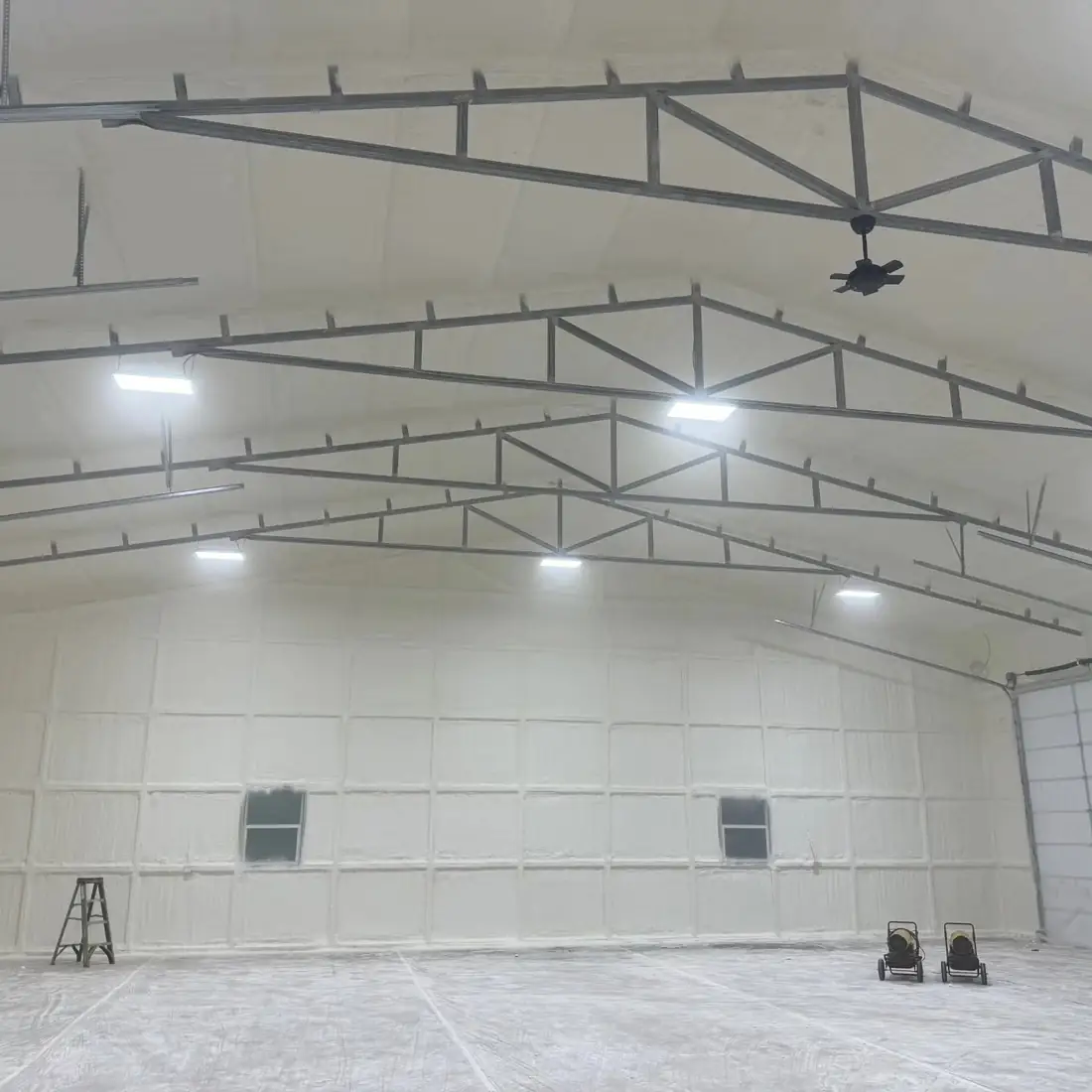
Warm, humid air inside the building touches a metal roof that's colder than the dew point and water condenses on it, then drips. Blanket insulation leaves an air gap against the panel, so the metal still gets cold and the fiberglass soaks up the drips. Closed cell foam bonds directly to the panel with no air gap. There is no cold surface for the air to reach, so there is nothing to condense on.
Closed cell on steel: what the thickness does
Closed cell delivers more R-value per inch than any common insulation and becomes a vapor retarder at the thickness your quote specifies. It also stiffens the panel it's sprayed on, which takes some of the drum out of a metal roof in wind and rain. Thickness is set by what you want the building to do: a conditioned shop needs more than a storage building you only want to stop dripping.
Not against the exterior panels. Open cell lets moisture pass through, which is the wrong property against cold steel. It can be a fit for interior partition walls or a framed office inside the shop.
Working shop vs. new shell
A new shell is the easiest job we do: open walls, empty floor, one or two days. A working shop takes staging. We cover equipment, lifts, and benches, work in zones so you can keep part of the floor open, and schedule around your hours when that helps. Tell us what can move and what can't and we plan the sequence around it.
What about the old blanket insulation?
It comes down. Foam has to bond to the panel to do its job, and old fiberglass is usually holding water, dust, and whatever the birds left. Removal and disposal is part of the quote when it applies.
How long does it take?
Most shops are finished in a day or two. Larger warehouses are scheduled in phases. Your quote has the plan, and we tell you before we start when each area will be clear to use again.